By Marcello Cherchi, MD PhD
For patients
“Brain fog” is not really a disease in itself, but people sometimes use the phrase “brain fog” to refer to problems with thinking and behavior. It can occur along with other diseases. Treatment of “brain fog” usually should be treating the other disease with which it occurs.
For clinicians
Overview
“Brain fog” has no universally accepted definition. It often consists of a constellation of cognitive, psychological and physiological symptoms occurring in the context of some other diagnosis, and has been reported in association with a broad range of diseases. The mechanism of “brain fog” is not understood, and it has no confirmatory test. Practically, treatment should be aimed at the disease in whose context “brain fog” is occurring. Other interventions (such as cognitive-behavioral therapy, neurofeedback, pharmacologic, etc.) are investigational.
Introduction
In clinical practice, English-speaking patients frequently use the colloquial phrase “brain fog.” Despite the absence of any clear definition, this phrase has found its way out of the vernacular into the medical literature, and as of this writing, a PubMed search for “brain fog” gets several hundred hits.
It is difficult to study a phenomenon if, in the absence of a clear definition, it cannot be consistently identified. Efforts to define the meaning of the phrase “brain fog” have included strategies such as scraping social media (McWhirter et al. 2023). More controlled approaches have attempted to define this phrase as it is used by patients suffering from a specific medical condition, such as celiac disease (Knowles et al. 2024), while others cast a broader net by surveying patients with a wide variety of diagnoses (Atik and Inel Manav 2023). Attempts at “re-tooling” other cognitive scales (such as the Montreal Cognitive Assessment) to identify “brain fog” have been unsatisfactory (Lynch et al. 2022).
Some analyses suggest that patients complaining of “brain fog” usually describe symptoms that fall under several broad categories. For example, Atik and Manav (Atik and Inel Manav 2023) suggest cognitive, physiological and psychological categories, as shown in the Table below.
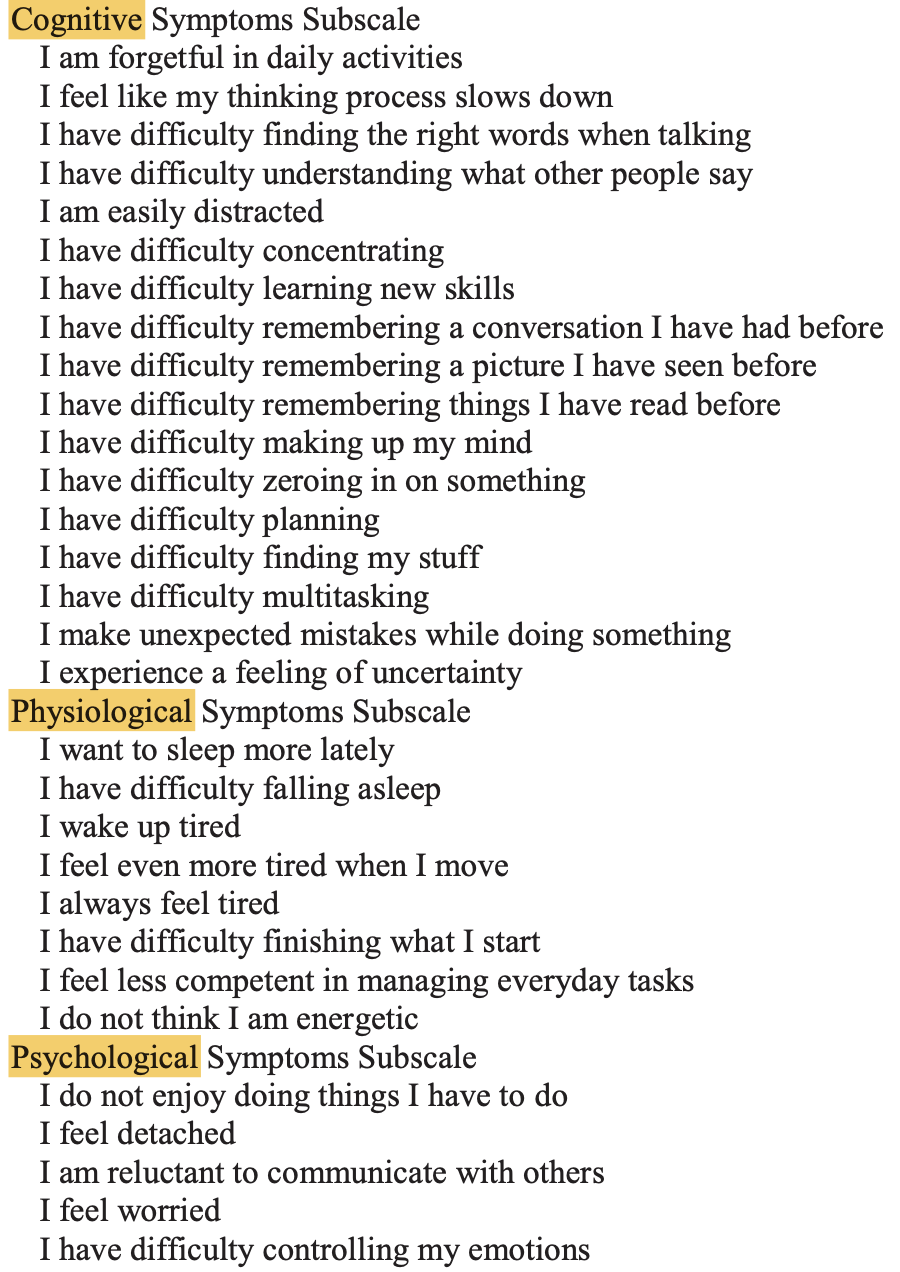
This approach has its merits, but since each subjective symptom has its own rather large differential diagnosis, the discriminatory power is limited. For example, a patient endorsing a subset of these symptoms would also easily meet the DSM-5tr criteria for clinical depression (American Psychiatric Association 2022), as shown below.
- Depressed mood
- “I feel detached”
- “I feel worried”
- “I have difficulty controlling my emotions”
- Loss of interest/pleasure
- “I do not enjoy doing things I have to do”
- Weight loss or gain
- N/A
- Insomnia or hypersomnia
- “I want to sleep more lately”
- “I have difficulty falling asleep”
- Psychomotor agitation or retardation
- “I feel like my thinking process slows down”
- Fatigue
- “I always feel tired”
- Feeling worthless or excessive/inappropriate guilt
- N/A
- Decreased concentration
- “I am easily distracted”
- “I have difficulty concentrating”
- Thoughts of death/suicide
- N/A
Epidemiology
“Brain fog” has been described in association with an impressive range of illnesses and conditions, including:
- Neurological disorders
- Traumatic brain injury (Bell et al. 2023; Elliott et al. 2023)
- Multiple sclerosis (Atik and Inel Manav 2023)
- Neurosarcoidosis (Atik and Inel Manav 2023)
- Mild cognitive impairment (Atik and Inel Manav 2023)
- Cardiovascular disorders
- Postural orthostatic tachycardia syndrome (Koch et al. 2023; Rodriguez et al. 2022; Ross et al. 2013; Wells et al. 2020)
- Dehydration (Atik and Inel Manav 2023)
- Gastrointestinal and hepatobiliary disorders
- Celiac disease (Croall et al. 2020; Knowles et al. 2024; Lebwohl and Ludvigsson 2014; Yelland 2017)
- Hepatitis C (Atik and Inel Manav 2023)
- Cirrhosis (Atik and Inel Manav 2023)
- Endocrinological disorders and hormonal states
- Hypothyroidism (Ettleson et al. 2022; Haskard-Zolnierek et al. 2022; Samuels and Bernstein 2022)
- Hypoparathyroidism (Elliott et al. 2023)
- Menopause (Hobson and Dennis 2024; Jaff and Maki 2021; Maki and Jaff 2022; Zhu et al. 2023)
- Pregnancy (Atik and Inel Manav 2023)
- Disorders of nutrition and metabolism
- Disorders of sodium metabolism (Atik and Inel Manav 2023)
- Vitamin B12 deficiency (Atik and Inel Manav 2023)
- Iron deficiency (Atik and Inel Manav 2023)
- Rheumatologic or autoimmune disorders
- Rheumatoid arthritis (Atik and Inel Manav 2023; Elliott et al. 2023)
- Chronic fatigue syndrome (Ocon 2013)
- Systemic lupus erythematosus (Kalim et al. 2020; Mackay 2015)
- Fibromyalgia (Elliott et al. 2023)
- Infectious disorders
- COVID-19 (Aghajani Mir 2023; Antar et al. 2023; Asadi-Pooya et al. 2022; Asadi-Pooya et al. 2023; Babiloni et al. 2024; Bowen and Arany 2023; Bulla et al. 2023; Callan et al. 2022; Chasco et al. 2022; Chatys-Bogacka et al. 2022; Chatys-Bogacka et al. 2023; Chatys-Bogacka et al. 2024; Del Brutto 2022; Delgado-Alonso et al. 2023; Doherty and Campbell 2024; Fernández-de-Las-Peñas et al. 2023; Finsterer 2022; Finsterer and Mehri 2023; Graham 2022, 2024; Gross et al. 2023; Hagiya et al. 2024; Hassan et al. 2023; Hugon 2022; Hugon et al. 2022; Ishikura et al. 2023; Jennings et al. 2022; Kavanagh 2022; Kazama 2023; Kopańska et al. 2022; Krishnan et al. 2022; Lam et al. 2023; Lanz-Luces et al. 2022; Lynch et al. 2022; Masuko and Sasai-Masuko 2024; Matias-Guiu et al. 2021; Menichetti 2023; Nordvig et al. 2023; Nouraeinejad 2022, 2023; Orfei et al. 2022; Rabaiotti et al. 2023; Reinfeld 2023; Sfera et al. 2023; Sia et al. 2023; Sklinda et al. 2021; Stefano et al. 2021; Taube 2023; Theoharides et al. 2021; Tsuchida et al. 2023; van der Feltz-Cornelis et al. 2024; Wang and Gandy 2022; Wojcik et al. 2023)
- Psychiatric disorders
- Depression (Atik and Inel Manav 2023)
- Anxiety (Atik and Inel Manav 2023)
- Autistic spectrum disorders (Atik and Inel Manav 2023)
- Miscellaneous
- Renal disease (Atik and Inel Manav 2023)
- Allergies (Atik and Inel Manav 2023)
- Chemotherapy (Atik and Inel Manav 2023)
Pathophysiological mechanism of disease
It is difficult to discern a pattern among these. Perhaps the most parsimonious (though not very useful) observation is simply that “brain fog” can occur in association with primary neuropsychiatric disease, and as a neuropsychiatric manifestation of the adverse neurological impact from the biochemical consequences of other medical conditions (cardiovascular, renal, metabolic, nutritional, endocrinological, autoimmune, rheumatologic, infectious, etc.).
Clinical presentation
See the section titled, “Introduction” (above).
Testing
There is not yet any serum marker, imaging study or other “test” for “brain fog.”
Differential diagnosis
See the section entitled, “Epidemiology” (above).
Treatment
Given how poorly understood “brain fog” is, it is hardly surprising that there is a dearth of literature on its treatment. In view of the broad array of diseases and states with which “brain fog” has been associated, it is probably unrealistic to view this as a single uniform disorder that might be treated or managed by a single intervention (Kverno 2021).
Practically:
- Since “brain fog” occurs in the context of other illnesses, it is reasonable to treat those other illnesses, if such treatment is available.
- Other interventions, usually aimed at “brain fog” occurring in the context of specific diseases, have been described in case reports and small case series, and should be viewed as investigational, including neurofeedback (Masuko and Sasai-Masuko 2024), cognitive-behavioral therapy (Muthumuni et al. 2023), “photobiomodulation” (Bowen and Arany 2023) and other non-invasive brain stimulation (Linnhoff et al. 2022), and psychiatric medications (Reinfeld 2023).
Prognosis
The prognosis is variable, and is likely to be partly dependent on the disease in whose context the “brain fog” is occurring.
References
Aghajani Mir M (2023) Brain Fog: a Narrative Review of the Most Common Mysterious Cognitive Disorder in COVID-19. Mol Neurobiol. doi: 10.1007/s12035-023-03715-y
American Psychiatric Association (2022) Diagnostic and statistical manual of mental disorders : DSM-5-TR, Fifth edition, text revision. edn. American Psychiatric Association Publishing, Washington, DC
Antar AAR, Yu T, Demko ZO, Hu C, Tornheim JA, Blair PW, Thomas DL, Manabe YC (2023) Long COVID brain fog and muscle pain are associated with longer time to clearance of SARS-CoV-2 RNA from the upper respiratory tract during acute infection. Front Immunol 14: 1147549. doi: 10.3389/fimmu.2023.1147549
Asadi-Pooya AA, Akbari A, Emami A, Lotfi M, Rostamihosseinkhani M, Nemati H, Barzegar Z, Kabiri M, Zeraatpisheh Z, Farjoud-Kouhanjani M, Jafari A, Sasannia S, Ashrafi S, Nazeri M, Nasiri S, Shahisavandi M (2022) Long COVID syndrome-associated brain fog. J Med Virol 94: 979-984. doi: 10.1002/jmv.27404
Asadi-Pooya AA, Shahisavandi M, Nemati H, Karimi A, Jafari A, Nasiri S, Mohammadi SS, Nemati M, Rahimian Z, Bayat H (2023) Long-Lasting COVID-Associated Brain Fog: A Follow-Up Study. Eur Neurol 86: 166-170. doi: 10.1159/000529860
Atik D, Inel Manav A (2023) A Scale Development Study: Brain Fog Scale. Psychiatr Danub 35: 73-79. doi: 10.24869/psyd.2023.73
Babiloni C, Gentilini Cacciola E, Tucci F, Vassalini P, Chilovi A, Jakhar D, Musat AM, Salvatore M, Soricelli A, Stocchi F, Vacca L, Ferri R, Catania V, Mastroianni C, D’Ettorre G, Noce G (2024) Resting-state EEG rhythms are abnormal in post COVID-19 patients with brain fog without cognitive and affective disorders. Clin Neurophysiol 161: 159-172. doi: 10.1016/j.clinph.2024.02.034
Bell T, Crowe M, Novack T, Davis RD, Stavrinos D (2023) Severity and correlates of brain fog in people with traumatic brain injury. Res Nurs Health 46: 136-147. doi: 10.1002/nur.22280
Bowen R, Arany PR (2023) Use of either transcranial or whole-body photobiomodulation treatments improves COVID-19 brain fog. J Biophotonics 16: e202200391. doi: 10.1002/jbio.202200391
Bulla R, Rossi L, Furlanis G, Agostinis C, Toffoli M, Balduit A, Mangogna A, Liccari M, Morosini G, Kishore U, Manganotti P (2023) A likely association between low mannan-binding lectin level and brain fog onset in long COVID patients. Front Immunol 14: 1191083. doi: 10.3389/fimmu.2023.1191083
Callan C, Ladds E, Husain L, Pattinson K, Greenhalgh T (2022) ‘I can’t cope with multiple inputs’: a qualitative study of the lived experience of ‘brain fog’ after COVID-19. BMJ Open 12: e056366. doi: 10.1136/bmjopen-2021-056366
Chasco EE, Dukes K, Jones D, Comellas AP, Hoffman RM, Garg A (2022) Brain Fog and Fatigue following COVID-19 Infection: An Exploratory Study of Patient Experiences of Long COVID. Int J Environ Res Public Health 19. doi: 10.3390/ijerph192315499
Chatys-Bogacka Z, Mazurkiewicz I, Slowik J, Bociaga-Jasik M, Dzieza-Grudnik A, Slowik A, Wnuk M, Drabik L (2022) Brain Fog and Quality of Life at Work in Non-Hospitalized Patients after COVID-19. Int J Environ Res Public Health 19. doi: 10.3390/ijerph191912816
Chatys-Bogacka Ż, Mazurkiewicz I, Słowik J, Nowak K, Sydor W, Wizner B, Słowik A, Wnuk M, Drabik L (2023) Sex-related patient-reported brain fog symptoms in non-hospitalised COVID-19 patients. Neurol Neurochir Pol 57: 111-120. doi: 10.5603/PJNNS.a2023.0010
Chatys-Bogacka Ż, Mazurkiewicz I, Słowik J, Słowik A, Drabik L, Wnuk M (2024) Association between brain fog, cardiac injury, and quality of life at work after hospitalization due to COVID-19. Med Pr 75: 3-17. doi: 10.13075/mp.5893.01428
Croall ID, Hoggard N, Aziz I, Hadjivassiliou M, Sanders DS (2020) Brain fog and non-coeliac gluten sensitivity: Proof of concept brain MRI pilot study. PLoS One 15: e0238283. doi: 10.1371/journal.pone.0238283
Del Brutto OH (2022) Cognitive sequelae of COVID-19, a post-pandemic threat. Should we be worried about the brain fog? Arq Neuropsiquiatr 80: 215-216. doi: 10.1590/0004-282x-anp-2022-e003
Delgado-Alonso C, Díez-Cirarda M, Pagán J, Pérez-Izquierdo C, Oliver-Mas S, Fernández-Romero L, Martínez-Petit Á, Valles-Salgado M, Gil-Moreno MJ, Yus M, Matías-Guiu J, Ayala JL, Matias-Guiu JA (2023) Unraveling brain fog in post-COVID syndrome: Relationship between subjective cognitive complaints and cognitive function, fatigue, and neuropsychiatric symptoms. Eur J Neurol. doi: 10.1111/ene.16084
Doherty CP, Campbell M (2024) Leaky blood-brain barrier in long-COVID-associated brain fog. Nat Neurosci 27: 395-396. doi: 10.1038/s41593-024-01577-8
Elliott TR, Hsiao YY, Randolph K, Urban RJ, Sheffield-Moore M, Pyles RB, Masel BE, Wexler T, Wright TJ (2023) Efficient assessment of brain fog and fatigue: Development of the Fatigue and Altered Cognition Scale (FACs). PLoS One 18: e0295593. doi: 10.1371/journal.pone.0295593
Ettleson MD, Raine A, Batistuzzo A, Batista SP, McAninch E, Teixeira M, Jonklaas J, Laiteerapong N, Ribeiro MO, Bianco AC (2022) Brain Fog in Hypothyroidism: Understanding the Patient’s Perspective. Endocr Pract 28: 257-264. doi: 10.1016/j.eprac.2021.12.003
Fernández-de-Las-Peñas C, Cancela-Cilleruelo I, Rodríguez-Jiménez J, Arias-Navalón JA, Martín-Guerrero JD, Pellicer-Valero OJ, Arendt-Nielsen L, Cigarán-Méndez M (2023) Trajectory of post-COVID brain fog, memory loss, and concentration loss in previously hospitalized COVID-19 survivors: the LONG-COVID-EXP multicenter study. Front Hum Neurosci 17: 1259660. doi: 10.3389/fnhum.2023.1259660
Finsterer J (2022) Metabolomics by magnetic resonance spectroscopy may not sufficiently explain “brain fog” in neuro-COVID. Pol J Radiol 87: e670-e671. doi: 10.5114/pjr.2022.123570
Finsterer J, Mehri S (2023) Post-COVID ‘brain fog’ will clear up only through neuropsychological examination. Neurol Neurochir Pol 57: 322-323. doi: 10.5603/PJNNS.a2023.0032
Graham F (2022) Daily briefing: The crushing ‘brain fog’ of long COVID. Nature. doi: 10.1038/d41586-022-02969-1
Graham F (2024) Daily briefing: COVID ‘brain fog’ linked to brain inflammation. Nature. doi: 10.1038/d41586-024-00881-4
Gross M, Lansang NM, Gopaul U, Ogawa EF, Heyn PC, Santos FH, Sood P, Zanwar PP, Schwertfeger J, Faieta J (2023) What Do I Need to Know About Long-Covid-related Fatigue, Brain Fog, and Mental Health Changes? Arch Phys Med Rehabil 104: 996-1002. doi: 10.1016/j.apmr.2022.11.021
Hagiya H, Tokumasu K, Otsuka Y, Sunada N, Nakano Y, Honda H, Furukawa M, Otsuka F (2024) Relevance of complement immunity with brain fog in patients with long COVID. J Infect Chemother 30: 236-241. doi: 10.1016/j.jiac.2023.10.016
Haskard-Zolnierek K, Wilson C, Pruin J, Deason R, Howard K (2022) The Relationship Between Brain Fog and Medication Adherence for Individuals With Hypothyroidism. Clin Nurs Res 31: 445-452. doi: 10.1177/10547738211038127
Hassan L, Ahsan Z, Bint ERH (2023) An Unusual Case of Blackout in a COVID-19 Patient: COVID-19 Brain Fog. Cureus 15: e36273. doi: 10.7759/cureus.36273
Hobson G, Dennis N (2024) “I can’t be dealing with this brain fog”: A workplace focus group study investigating factors underpinning the menopausal experience for NHS staff. Maturitas 180: 107889. doi: 10.1016/j.maturitas.2023.107889
Hugon J (2022) Long-COVID: Cognitive deficits (brain fog) and brain lesions in non-hospitalized patients. Presse Med 51: 104090. doi: 10.1016/j.lpm.2021.104090
Hugon J, Msika EF, Queneau M, Farid K, Paquet C (2022) Long COVID: cognitive complaints (brain fog) and dysfunction of the cingulate cortex. J Neurol 269: 44-46. doi: 10.1007/s00415-021-10655-x
Ishikura T, Nakano T, Kitano T, Tokuda T, Sumi-Akamaru H, Naka T (2023) Serum ferritin level during hospitalization is associated with Brain Fog after COVID-19. Sci Rep 13: 13095. doi: 10.1038/s41598-023-40011-0
Jaff NG, Maki PM (2021) Scientific insights into brain fog during the menopausal transition. Climacteric 24: 317-318. doi: 10.1080/13697137.2021.1942700
Jennings G, Monaghan A, Xue F, Duggan E, Romero-Ortuño R (2022) Comprehensive Clinical Characterisation of Brain Fog in Adults Reporting Long COVID Symptoms. J Clin Med 11. doi: 10.3390/jcm11123440
Kalim H, Pratama MZ, Mahardini E, Winoto ES, Krisna PA, Handono K (2020) Accelerated immune aging was correlated with lupus-associated brain fog in reproductive-age systemic lupus erythematosus patients. Int J Rheum Dis 23: 620-626. doi: 10.1111/1756-185x.13816
Kavanagh E (2022) Long Covid brain fog: a neuroinflammation phenomenon? Oxf Open Immunol 3: iqac007. doi: 10.1093/oxfimm/iqac007
Kazama I (2023) Brain Leukocytes as the Potential Therapeutic Target for Post-COVID-19 Brain Fog. Neurochem Res 48: 2345-2349. doi: 10.1007/s11064-023-03912-0
Knowles SR, Apputhurai P, Tye-Din JA (2024) Development and validation of a brain fog scale for coeliac disease. Aliment Pharmacol Ther 59: 1260-1270. doi: 10.1111/apt.17942
Koch SA, Jarjour IT, Evankovich KD (2023) Neurocognitive Profiles in Adolescents With Postural Tachycardia Syndrome and Perceived Brain Fog: A Preliminary Report. Pediatr Neurol 148: 128-132. doi: 10.1016/j.pediatrneurol.2023.08.011
Kopańska M, Ochojska D, Muchacka R, Dejnowicz-Velitchkov A, Banaś-Ząbczyk A, Szczygielski J (2022) Comparison of QEEG Findings before and after Onset of Post-COVID-19 Brain Fog Symptoms. Sensors (Basel) 22. doi: 10.3390/s22176606
Krishnan K, Lin Y, Prewitt KM, Potter DA (2022) Multidisciplinary Approach to Brain Fog and Related Persisting Symptoms Post COVID-19. J Health Serv Psychol 48: 31-38. doi: 10.1007/s42843-022-00056-7
Kverno K (2021) Brain Fog: A Bit of Clarity Regarding Etiology, Prognosis, and Treatment. J Psychosoc Nurs Ment Health Serv 59: 9-13. doi: 10.3928/02793695-20211013-01
Lam GY, Damant RW, Ferrara G, Lim RK, Stickland MK, Ogando NS, Power C, Smith MP (2023) Characterizing long-COVID brain fog: a retrospective cohort study. J Neurol 270: 4640-4646. doi: 10.1007/s00415-023-11913-w
Lanz-Luces JR, Aceituno H, Quiroz-Bravo F, Rodríguez-Flores F, Osores-Espinoza M, Rigaud D, Pérez-Cuesta D, Khan A, Tobar-Bustamente A, Barrancas A, Figueroa-Torres C, de la Cruz JG, Burgos-Alarcón F, Gómez-Donoso J (2022) Long-lasting brain fog is related with severity clusters of symptoms in COVID-19 patients. Rev Med Chil 150: 1484-1492. doi: 10.4067/s0034-98872022001101484
Lebwohl B, Ludvigsson JF (2014) Editorial: ‘brain fog’ and coeliac disease – evidence for its existence. Aliment Pharmacol Ther 40: 565. doi: 10.1111/apt.12852
Linnhoff S, Koehler L, Haghikia A, Zaehle T (2022) The therapeutic potential of non-invasive brain stimulation for the treatment of Long-COVID-related cognitive fatigue. Front Immunol 13: 935614. doi: 10.3389/fimmu.2022.935614
Lynch S, Ferrando SJ, Dornbush R, Shahar S, Smiley A, Klepacz L (2022) Screening for brain fog: Is the montreal cognitive assessment an effective screening tool for neurocognitive complaints post-COVID-19? Gen Hosp Psychiatry 78: 80-86. doi: 10.1016/j.genhosppsych.2022.07.013
Mackay M (2015) Lupus brain fog: a biologic perspective on cognitive impairment, depression, and fatigue in systemic lupus erythematosus. Immunol Res 63: 26-37. doi: 10.1007/s12026-015-8716-3
Maki PM, Jaff NG (2022) Brain fog in menopause: a health-care professional’s guide for decision-making and counseling on cognition. Climacteric 25: 570-578. doi: 10.1080/13697137.2022.2122792
Masuko T, Sasai-Masuko H (2024) Efficacy of Original Neurofeedback Treatment Method for Brain Fog From COVID-19: A Case Report. Cureus 16: e56519. doi: 10.7759/cureus.56519
Matias-Guiu JA, Delgado-Alonso C, Yus M, Polidura C, Gómez-Ruiz N, Valles-Salgado M, Ortega-Madueño I, Cabrera-Martín MN, Matias-Guiu J (2021) “Brain Fog” by COVID-19 or Alzheimer’s Disease? A Case Report. Front Psychol 12: 724022. doi: 10.3389/fpsyg.2021.724022
McWhirter L, Smyth H, Hoeritzauer I, Couturier A, Stone J, Carson AJ (2023) What is brain fog? J Neurol Neurosurg Psychiatry 94: 321-325. doi: 10.1136/jnnp-2022-329683
Menichetti F (2023) The Potential Role of Hypothalamic Phospholipid Liposomes in the Supportive Therapy of Some Manifestations of Post-COVID-19 Condition: Myalgic Encephalomyelitis/Chronic Fatigue Syndrome (ME/CFS) and Brain Fog. J Clin Med 12. doi: 10.3390/jcm12175478
Muthumuni D, Scott I, Chochinov HM, Mahar AL, Garland SN, Schulte F, Lambert P, Lix L, Garland A, Oberoi S (2023) Feasibility and Acceptability of a Virtual “Coping with Brain Fog” Intervention for Improving Cognitive Functioning in Young Adults with Cancer. J Adolesc Young Adult Oncol 12: 662-673. doi: 10.1089/jayao.2023.0022
Nordvig AS, Rajan M, Lau JD, Kingery JR, Mahmud M, Chiang GC, De Leon MJ, Goyal P (2023) Brain fog in long COVID limits function and health status, independently of hospital severity and preexisting conditions. Front Neurol 14: 1150096. doi: 10.3389/fneur.2023.1150096
Nouraeinejad A (2022) The pathological mechanisms underlying brain fog or cognitive impairment in long COVID. Int J Neurosci: 1-2. doi: 10.1080/00207454.2022.2150845
Nouraeinejad A (2023) Brain fog as a Long-term Sequela of COVID-19. SN Compr Clin Med 5: 9. doi: 10.1007/s42399-022-01352-5
Ocon AJ (2013) Caught in the thickness of brain fog: exploring the cognitive symptoms of Chronic Fatigue Syndrome. Front Physiol 4: 63. doi: 10.3389/fphys.2013.00063
Orfei MD, Porcari DE, D’Arcangelo S, Maggi F, Russignaga D, Ricciardi E (2022) A New Look on Long-COVID Effects: The Functional Brain Fog Syndrome. J Clin Med 11. doi: 10.3390/jcm11195529
Rabaiotti P, Ciracì C, Donelli D, Oggioni C, Rizzi B, Savi F, Antonelli M, Rizzato M, Moderato L, Brambilla V, Ziveri V, Brambilla L, Bini M, Nouvenne A, Lazzeroni D (2023) Effects of Multidisciplinary Rehabilitation Enhanced with Neuropsychological Treatment on Post-Acute SARS-CoV-2 Cognitive Impairment (Brain Fog): An Observational Study. Brain Sci 13. doi: 10.3390/brainsci13050791
Reinfeld S (2023) Can bupropion treat COVID-19-induced brain fog? A case series. Int Clin Psychopharmacol 38: 189-191. doi: 10.1097/yic.0000000000000436
Rodriguez B, Hochstrasser A, Eugster PJ, Grouzmann E, Müri RM, Z’Graggen WJ (2022) Brain fog in neuropathic postural tachycardia syndrome may be associated with autonomic hyperarousal and improves after water drinking. Front Neurosci 16: 968725. doi: 10.3389/fnins.2022.968725
Ross AJ, Medow MS, Rowe PC, Stewart JM (2013) What is brain fog? An evaluation of the symptom in postural tachycardia syndrome. Clin Auton Res 23: 305-11. doi: 10.1007/s10286-013-0212-z
Samuels MH, Bernstein LJ (2022) Brain Fog in Hypothyroidism: What Is It, How Is It Measured, and What Can Be Done About It. Thyroid 32: 752-763. doi: 10.1089/thy.2022.0139
Sfera A, Rahman L, Zapata-Martín Del Campo CM, Kozlakidis Z (2023) Long COVID as a Tauopathy: Of “Brain Fog” and “Fusogen Storms”. Int J Mol Sci 24. doi: 10.3390/ijms241612648
Sia AL, Neo JE, Jen-Wei Tan B, Tan EK (2023) “Brain fog” and COVID-19. Am J Med Sci 365: 472-474. doi: 10.1016/j.amjms.2023.01.003
Sklinda K, Górecki A, Dorobek M, Walecki J, Modrzyńska A, Mruk B (2021) Ischaemic background of brain fog in long-haul COVID-19 – a nuclear magnetic resonance spectroscopy-based metabonomic analysis. Preliminary results. Pol J Radiol 86: e654-e660. doi: 10.5114/pjr.2021.111100
Stefano GB, Ptacek R, Ptackova H, Martin A, Kream RM (2021) Selective Neuronal Mitochondrial Targeting in SARS-CoV-2 Infection Affects Cognitive Processes to Induce ‘Brain Fog’ and Results in Behavioral Changes that Favor Viral Survival. Med Sci Monit 27: e930886. doi: 10.12659/msm.930886
Taube M (2023) Depression and brain fog as long-COVID mental health consequences: Difficult, complex and partially successful treatment of a 72-year-old patient-A case report. Front Psychiatry 14: 1153512. doi: 10.3389/fpsyt.2023.1153512
Theoharides TC, Cholevas C, Polyzoidis K, Politis A (2021) Long-COVID syndrome-associated brain fog and chemofog: Luteolin to the rescue. Biofactors 47: 232-241. doi: 10.1002/biof.1726
Tsuchida T, Sasaki N, Ohira Y (2023) Low brain blood flow finding on SPECT in long COVID patients with brain fog. Qjm 116: 877-878. doi: 10.1093/qjmed/hcad135
van der Feltz-Cornelis C, Turk F, Sweetman J, Khunti K, Gabbay M, Shepherd J, Montgomery H, Strain WD, Lip GYH, Wootton D, Watkins CL, Cuthbertson DJ, Williams N, Banerjee A (2024) Prevalence of mental health conditions and brain fog in people with long COVID: A systematic review and meta-analysis. Gen Hosp Psychiatry 88: 10-22. doi: 10.1016/j.genhosppsych.2024.02.009
Wang Y, Gandy S (2022) The Golgi apparatus: Site for convergence of COVID-19 brain fog and Alzheimer’s disease? Mol Neurodegener 17: 67. doi: 10.1186/s13024-022-00568-2
Wells R, Paterson F, Bacchi S, Page A, Baumert M, Lau DH (2020) Brain fog in postural tachycardia syndrome: An objective cerebral blood flow and neurocognitive analysis. J Arrhythm 36: 549-552. doi: 10.1002/joa3.12325
Wojcik GM, Shriki O, Kwasniewicz L, Kawiak A, Ben-Horin Y, Furman S, Wróbel K, Bartosik B, Panas E (2023) Investigating brain cortical activity in patients with post-COVID-19 brain fog. Front Neurosci 17: 1019778. doi: 10.3389/fnins.2023.1019778
Yelland GW (2017) Gluten-induced cognitive impairment (“brain fog”) in coeliac disease. J Gastroenterol Hepatol 32 Suppl 1: 90-93. doi: 10.1111/jgh.13706
Zhu C, Thomas EH, Li Q, Arunogiri S, Thomas N, Gurvich C (2023) Evaluation of the Everyday Memory Questionnaire-Revised in a menopausal population: understanding the brain fog during menopause. Menopause 30: 1147-1156. doi: 10.1097/gme.0000000000002256
