By Marcello Cherchi, MD PhD
For patients
Centripetal nystagmus is an unusual abnormal eye movement that can happen when a part of the brain called the cerebellum is damaged.
For clinicians
Overview
Centripetal nystagmus is an ocular motor pattern in which at extreme lateral gaze there is jerk nystagmus whose fast phase beats towards primary position of gaze. This rare pattern has been observed in several neurodegenerative processes probably involving the cerebellum.
Introduction
Centripetal nystagmus is an ocular motor pattern in which at extreme lateral gaze there is jerk nystagmus whose fast phase beats towards primary position of gaze — in other words, at extreme right gaze there is left beat nystagmus, and at extreme left gaze there is right beat nystagmus.
Epidemiology
Centripetal nystagmus is a very rare ocular motor finding, reported with cerebellar disease (Leech et al. 1977), Creutzfeldt-Jakob disease (Helmchen and Büttner 1995), anti-GAD65-associated stiff person syndrome (Hac et al. 2023), as part of an anti-NMDA paraneoplastic syndrome (Cherchi and Hac 2023), and in blindness (Oh et al. 2024).
Pathophysiological mechanism of disease
Control systems analysis models predict that centripetal nystagmus can happen when gain of the neural integrator for horizontal eye movements in the nucleus prepositus hypoglossi (NPH) is greater than 1 (Optican and Zee 1984). In principle this should be possible with abnormal excitation. However, the diseases in which centripetal nystagmus occurs are destructive processes, so we submit it is more likely that inhibitory input to the NPH is impaired, leading to disinhibition (Cherchi and Hac 2023). Candidate inhibitory afferents to the NPH include projections from the cerebellar flocculus, paraflocculus, and fastigial nuclei (McCrea et al. 1979).
Clinical presentation
The ocular motor findings of centripetal nystagmus are very striking, though the clinical picture is usually dominated by other features of the various neurodegenerative processes in which it occurs.
Ocular motor examination
At extreme lateral gaze there is jerk nystagmus whose fast phase beats towards primary position of gaze. In several of the reported cases, centripetal nystagmus may occur in conjunction with other ocular motor abnormalities.
The Video below is an example of centripetal nystagmus occurring as part of an anti-NMDA paraneoplastic syndrome secondary to a mature ovarian teratoma (Cherchi and Hac 2023)
Instrumented ocular motor testing
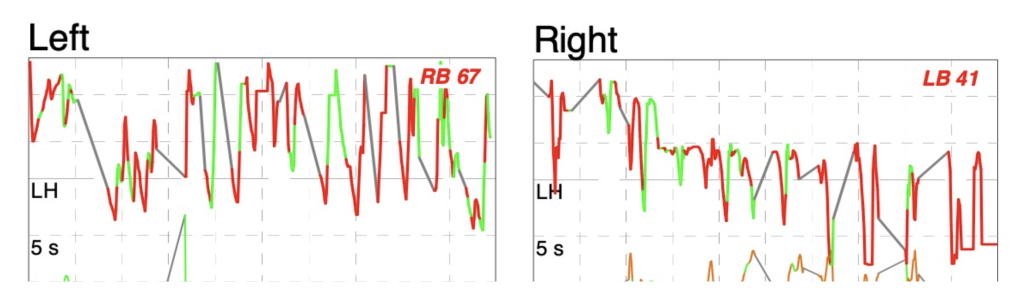
The Figure below shows part of the ocular motor tracings of a patient with centripetal nystagmus occurring as part of an NMDA paraneoplastic syndrome secondary to a mature ovarian teratoma (Cherchi and Hac 2023). In the Figure, each panel shows 5 seconds (“5 s”) of the ocular motor tracing of the left eye horizontal channel (“LH”). The left panel shows right beat nystagmus of 67 degrees per second (“RB 67”) at extreme left gaze. The right panel shows left beat nystagmus of 41 degrees per second (“LB 41”) at extreme right gaze.
Differential diagnosis
The differential diagnosis of centripetal nystagmus primarily consists of cerebellar lesions and visual loss.
Treatment and prognosis
The treatment (if any) and prognosis depend on the underlying etiology.
References
Cherchi M, Hac NEF (2023) Paraneoplastic Gaze-Evoked Centripetal Nystagmus in Ovarian Teratoma. Journal of Neuro-Ophthalmology. doi: 10.1097/WNO.0000000000002027
Hac NEF, Murphy OC, Butala AA, Newsome SD, Gold DR (2023) Centripetal Nystagmus, Slow Saccades, Cerebellar Ataxia, and Parkinsonism in a Patient With Anti-GAD65-Associated Stiff Person Syndrome Spectrum Disorder. Journal of Neuro-Ophthalmology: 1-5. doi: 10.1097/WNO.0000000000001774
Helmchen C, Büttner U (1995) Centripetal nystagmus in a case of Creutzfeldt-Jacob disease. Neuro-Ophthalmology 15: 187-192. doi: 10.3109/01658109509044601
Leech J, Gresty M, Hess K, Rudge P (1977) Gaze failure, drifting eye movements, and centripetal nystagmus in cerebellar disease. Br J Ophthalmol 61: 774-81. doi: 10.1136/bjo.61.12.774
McCrea RA, Baker R, Delgado-Garcia J (1979) Afferent and efferent organization of the prepositus hypoglossi nucleus. Prog Brain Res 50: 653-65. doi: 10.1016/S0079-6123(08)60863-8
Oh EH, Choi SY, Choi KD, Choi JH (2024) Teaching Video NeuroImage: Centripetal Nystagmus in Blindness. Neurology 103: e209794. doi: 10.1212/WNL.0000000000209794
Optican LM, Zee DS (1984) A hypothetical explanation of congenital nystagmus. Biol Cybern 50: 119-34. doi: 10.1007/BF00337159
