By Marcello Cherchi, MD PhD
For patients
Motion sickness is a common human experience. While this is often depicted as a “disease” in medical literature, we hesitate to pathologize it in that fashion, since human beings did not evolve to travel in space shuttles and use immersive virtual reality video games. Nevertheless, since many people experience motion sickness during vehicular travel, it can still limit a person’s activities, whether or not one classifies it as a “disease.”
The most common strategy for managing motion sickness is to avoid the trigger, and while this is effective, it is not always feasible. Other well-studied approaches include various medications. Less well-studied approaches include motion sickness wristbands, habituation/desensitization, and others.
For clinicians
Overview
Motion sickness, sometimes referred to in medical literature as “constitutional motion sensitivity,” is a common human experience. The most commonly cited (though not universally accepted) theory is that motion sickness arises from a failure of sensory integration when confronted with discrepant sensory inputs (vestibular, visual, proprioceptive), which most commonly occurs when an individual is undergoing passive motion (such as in a vehicle). Heightened susceptibility to motion sickness may occur in patients with other diseases, such as migraine or vestibular lesions. Management options for motion sickness include trigger avoidance, habituation/desensitization, medication, migraine prophylaxis, motion sickness wristbands, and others.
Terminology
Medical literature often uses the phrase “constitutional motion sensitivity” to refer to what is more colloquially known as “motion sickness.”
Theory of sensory conflict
Probably the most widely (though not universally) accepted theory of motion sickness maintains that the underlying mechanism of disease is sensory conflict (Zhang, Wang et al. 2016).
The brain calculates the body’s orientation in, and movement through, space by taking into account multiple sensory inputs (vestibular, visual, proprioceptive, tactile, and to a small degree auditory), as well as the internal-model-predicted consequences of planned motor output (engrams). The brain integrates the various sensory inputs and tries to match them with predictions from its internal models. When the sensory inputs are concordant and match predictions from the internal model, the system functions properly. In contrast, if sensory inputs are discrepant (fail to integrate), or if they do not match predictions from the internal model, a person may experience discomfort in the form of motion sensitivity.
Motion sensitivity can be experienced when a person is in a vehicle, elevator, escalator, conveyor belt, etc. These are all examples of passive motion — a person’s body is being moved by some external force, not by the person’s voluntary activity. In this circumstance there is likely to be a discrepancy between visual, vestibular and somatosensory inputs.
Cybersickness (Gallagher and Ferre 2018, Eftekharifar, Thaler et al. 2021, Laessoe, Abrahamsen et al. 2022) can provoke sensations similar to motion sickness, but the term “cybersickness” usually refers to a circumstance in which the predominantly variable sensory input is vision, such as when playing immersive virtual reality videogames. Similar to more mundane motion sickness, in cybersickness there is a sensory conflict between visual cues (which suggest motion) and other inputs (vestibular, somatosensory) that suggest stasis.
Demographics
Constitutional motion sensitivity is generally thought to be “hard-wired,” though can vary over the course of a person’s life. It is common for a person to experience motion sensitivity more during childhood and less during adulthood, though the reverse can also occur.
Predisposing factors
It has been frequency observed that some diseases, such as migraine (Kuritzky, Ziegler et al. 1981, Cuomo-Granston and Drummond 2010, Furman and Marcus 2012, Wang and Lewis 2016, Abouzari, Cheung et al. 2020, Wurthmann, Naegel et al. 2021), appear to be associated with higher rates of motion sensitivity.
If a person with motion sensitivity becomes afflicted with a vestibular disorder, then these may have a synergistic effect (Golding and Patel 2017, Strupp, Brandt et al. 2018).
Workup
Individuals with constitutional motion sensitivity who are otherwise healthy usually have normal physical examinations and no detectable abnormalities on otovestibular testing.
When an individual experiences an abrupt increase in their baseline motion sensitivity, it is medically reasonable to undertake a screening otovestibular workup to explore whether an independently occurring vestibular disease is superimposed (Golding and Patel 2017, Strupp, Brandt et al. 2018).
Treatment
Trigger avoidance
Trigger avoidance is a common strategy for managing constitutional motion sensitivity. For example, an individual who becomes easily “sea sick” will often simply avoid traveling by boat.
This can be successful, though in some circumstances may be impractical. For example, if a person is motion sensitive in buses, yet must take the bus to and from work every day, then trigger avoidance may simply be infeasible.
Habituation/desensitization
Desensitization exercises essentially involve repeatedly exposing an individual to stimuli/situations that provoke motion sensitivity, in the expectation that such repeated exposure will eventually reduce the motion sensitivity (Bles, Bos et al. 2000, Cheung and Hofer 2005). One such protocol is the Puma method, developed by a flight surgeon (Dr. Puma) for the treatment of combat pilots who were experiencing motion sickness who were not permitted to be on centrally-acting medications (Puma and Puma 2007). The advantage of this approach is that it does not require medication. The disadvantage is that it entails considerable discomfort, at least initially.
Medication
A number of medications from different classes have been used in managing motion sickness. Broadly these include anti-histamines, anti-cholinergic medications, dopamine blockers and benzodiazepines. While sometimes effective, the disadvantage of this approach is that it involves medications and their potential adverse effects.
Treatment for migraine
Since migraine can be construed as a state of potential hypersensitivity, treatment for migraine can be considered (Lee, Jeong et al. 2018). This is very reasonable in patients already diagnosed with migraine. What has been less explored is whether this approach (treating for migraine) is applicable for managing motion sickness in patients with no history of migraine.
Motion sickness wristbands and acupressure
There is a modest literature regarding motion sickness wristbands (Atkinson 2003, Miller and Muth 2004). Some studies find this to be efficacious (Stern, Jokerst et al. 2001, Cox, Singh et al. 2011) while others do not (Bruce, Golding et al. 1990, Miller and Muth 2004). The advantage of this approach is that it incurs no medical risk.
The supposed mechanism of motion sickness wristbands is that they act on acupressure points. Here, too, studies are mixed with respect to the efficacy of acupressure, with some studies documenting efficacy (Hu, Stritzel et al. 1995) and others not (Warwick-Evans, Masters et al. 1991).
Horizon glasses
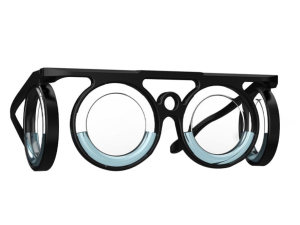
Hubert Jeannin invented and patented “boarding glasses” (USOO67832.37B1, https://patentimages.storage.googleapis.com/f2/c5/fb/969b082c755865/US6783237.pdf), claim to “cure motion sickness in 94% of cases in 10 minutes.” These glasses consist of frames with liquid levels immediately anterior to the eyes (in the coronal plane), and also lateral to the eyes (in the sagittal plane), that are intended to “create an artificial horizon in the field of view which helps to resynchronize the eyes with the balance system.” As of this writing we had not seen any peer-reviewed literature regarding the efficacy of this device, even on the inventor’s own ResearchGate page (https://www.researchgate.net/profile/Hubert-Jeannin/research).

References
Abouzari M, Cheung D, Pham T, Goshtasbi K, Sarna B, Tajran S, Sahyouni S, Lin HW, Djalilian HR (2020) The Relationship Between Vestibular Migraine and Motion Sickness Susceptibility. Otol Neurotol 41: 1116-1121. doi: 10.1097/MAO.0000000000002705
Atkinson HG (2003) Are acupressure wrist bands helpful for motion sickness? Health News 9: 12.
Bles W, Bos JE, Kruit H (2000) Motion sickness. Curr Opin Neurol 13: 19-25. doi: 10.1097/00019052-200002000-00005
Bruce DG, Golding JF, Hockenhull N, Pethybridge RJ (1990) Acupressure and motion sickness. Aviat Space Environ Med 61: 361-5.
Cheung B, Hofer K (2005) Desensitization to strong vestibular stimuli improves tolerance to simulated aircraft motion. Aviat Space Environ Med 76: 1099-104.
Cox DJ, Singh H, Cox DM (2011) Effectiveness of acupressure and acustimulation in minimizing driving simulation adaptation syndrome. Mil Med 176: 1440-3. doi: 10.7205/milmed-d-11-00013
Cuomo-Granston A, Drummond PD (2010) Migraine and motion sickness: what is the link? Prog Neurobiol 91: 300-12. doi: 10.1016/j.pneurobio.2010.04.001
Eftekharifar S, Thaler A, Bebko AO, Troje NF (2021) The role of binocular disparity and active motion parallax in cybersickness. Exp Brain Res 239: 2649-2660. doi: 10.1007/s00221-021-06124-6
Furman JM, Marcus DA (2012) Migraine and motion sensitivity. Continuum (Minneap Minn) 18: 1102-17. doi: 10.1212/01.CON.0000421621.18407.96
Gallagher M, Ferre ER (2018) Cybersickness: a Multisensory Integration Perspective. Multisens Res 31: 645-674. doi: 10.1163/22134808-20181293
Golding JF, Patel M (2017) Meniere’s, migraine, and motion sickness. Acta Otolaryngol 137: 495-502. doi: 10.1080/00016489.2016.1255775
Hu S, Stritzel R, Chandler A, Stern RM (1995) P6 acupressure reduces symptoms of vection-induced motion sickness. Aviat Space Environ Med 66: 631-4.
Kuritzky A, Ziegler DK, Hassanein R (1981) Vertigo, motion sickness and migraine. Headache 21: 227-31. doi: 10.1111/j.1526-4610.1981.hed2105227.x
Laessoe U, Abrahamsen S, Zepernick S, Raunsbaek A, Stensen C (2022) Motion sickness and cybersickness – Sensory mismatch. Physiol Behav 258: 114015. doi: 10.1016/j.physbeh.2022.114015
Lee SH, Jeong SH, Kim JS, Kim HJ, Choi KD, Choi JH, Oh SY, Park JY, Kim DU, Kim BK (2018) Effect of Prophylactic Medication on Associated Dizziness and Motion Sickness in Migraine. Otol Neurotol 39: e45-e51. doi: 10.1097/MAO.0000000000001628
Miller KE, Muth ER (2004) Efficacy of acupressure and acustimulation bands for the prevention of motion sickness. Aviat Space Environ Med 75: 227-34.
Puma SC, Puma SW (2007) Method for conditioning to prevent motion sickness. In: Office USPaT (ed), G16H 20/30 (20180101); A63B 23/00 (20130101); A63B 24/0075 (20130101) edn, vol 7,288,057, United States
Stern RM, Jokerst MD, Muth ER, Hollis C (2001) Acupressure relieves the symptoms of motion sickness and reduces abnormal gastric activity. Altern Ther Health Med 7: 91-4.
Strupp M, Brandt T, Huppert D, Grill E (2018) Prevalence of motion sickness in various vestibular disorders: a study on 749 patients. J Neurol. doi: 10.1007/s00415-018-8961-1
Wang J, Lewis RF (2016) Contribution of intravestibular sensory conflict to motion sickness and dizziness in migraine disorders. J Neurophysiol 116: 1586-1591. doi: 10.1152/jn.00345.2016
Warwick-Evans LA, Masters IJ, Redstone SB (1991) A double-blind placebo controlled evaluation of acupressure in the treatment of motion sickness. Aviat Space Environ Med 62: 776-8.
Wurthmann S, Naegel S, Roesner M, Nsaka M, Scheffler A, Kleinschnitz C, Holle D, Obermann M (2021) Sensitized rotatory motion perception and increased susceptibility to motion sickness in vestibular migraine: A cross-sectional study. Eur J Neurol 28: 2357-2366. doi: 10.1111/ene.14889
Zhang LL, Wang JQ, Qi RR, Pan LL, Li M, Cai YL (2016) Motion Sickness: Current Knowledge and Recent Advance. CNS Neurosci Ther 22: 15-24. doi: 10.1111/cns.12468
