By Marcello Cherchi, MD PhD
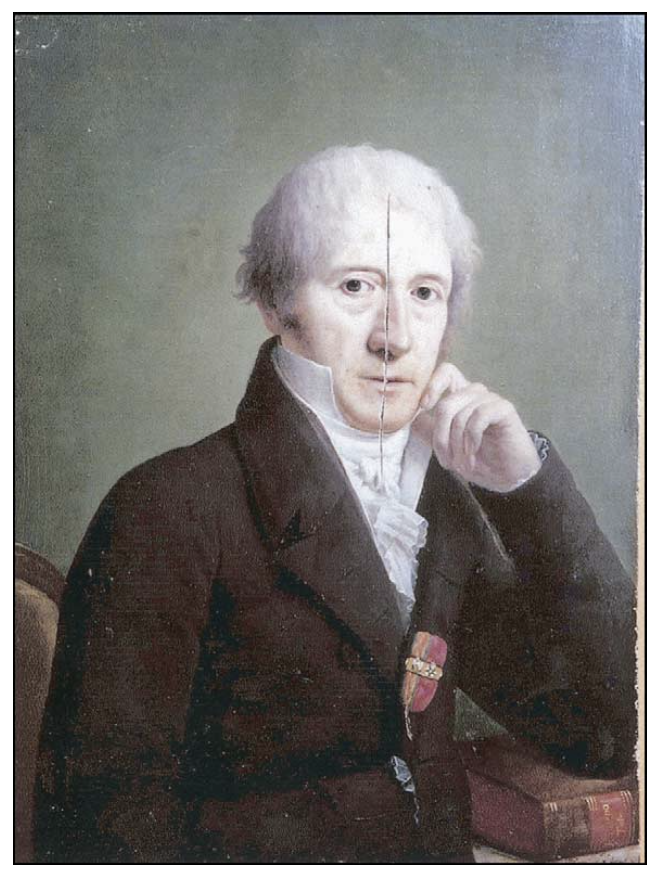
Antonio Scarpa (Motta di Livenza, 1752 – 1832) earned his medical degree in 1770 and became a professor at the University of Modena, where he subsequently took the position of chair of anatomy in 1783 (Fye 1997). He became an honorary member of the Royal Society of London in 1791 and of the Royal Swedish Academy of Sciences in 1821 (Grzybowski and Sak 2013).
In the first edition of Scarpa’s Anatomicae disquisitions de auditu et olfactu (Anatomical investigations on hearing and smell) he described and illustrated a number of features of the labyrinth, including the endolymph, the cochlear nerve, the vestibular nerve, the spiral ligament, the cochlear duct, and the vestibular ganglion (Canalis et al. 2001), the latter of which is sometimes referred to as “Scarpa’s ganglion.”
References
Canalis RF, Mira E, Bonandrini L, Hinojosa R (2001) Antonio Scarpa and the discovery of the membranous inner ear. Otol Neurotol 22: 105-12. doi: 10.1097/00129492-200101000-00020
Fye WB (1997) Antonio Scarpa. Clin Cardiol 20: 411-2. doi: 10.1002/clc.4960200422
Grzybowski A, Sak J (2013) Antonio Scarpa (1752-1832). J Neurol 260: 695-6. doi: 10.1007/s00415-012-6658-4
Parigi GB (2004) Antonio Scarpa was an outstanding “head” in the history of surgery. Am J Surg 188: 17-21. doi: 10.1016/j.amjsurg.2003.12.057
