By Marcello Cherchi, MD PhD
Introduction
The vestibular component of the labyrinth is phylogenetically older than the auditory component (Manley and Koppl 1998). The auditory component’s cochlea evolved a highly developed frequency discriminating capability for detecting and analyzing acoustic stimuli. The vestibular component of the labyrinth also has a frequency discriminating capability, although it is less well-developed than the auditory component in this regard.
Physiology
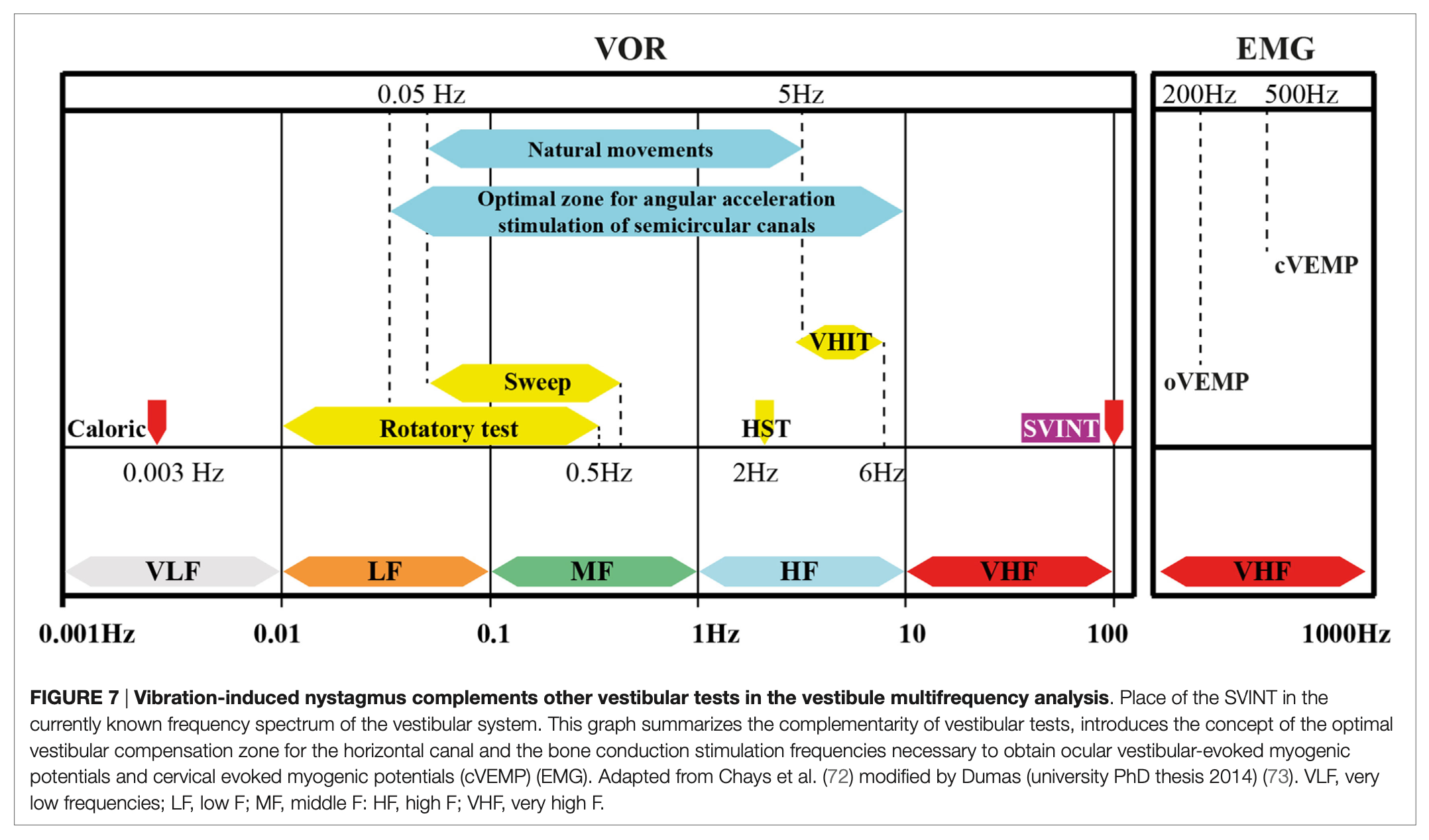
In the vestibular component of the labyrinth — which essentially functions as an accelerometer for rotational and translational movements — “frequency” refers to the magnitude of acceleration (Beraneck and Straka 2011), and is homologous to the cochlea (Ciuman 2011). In the cochlea, a particular type 1 hair cell tends to be maximally stimulated by vibration (oscillating acceleration) at a specific frequency. In the vestibular organelles, a particular type 1 hair cell tends to be maximally stimulated by acceleration of a specific magnitude (Highstein et al. 2005; Iversen and Rabbitt 2017; Songer and Eatock 2013; Straka et al. 2009). This is the case in various animal species (Haque et al. 2004; Highstein et al. 2005; Liu et al. 2020; Straka and Dieringer 2004), including humans (Dumas et al. 2017; Todd et al. 2009).
The Figure below, from Dumas and colleagues (Dumas et al. 2017), provides a schematic depiction of the vestibular tuning spectrum.
Significance
Although the ability to assess vestibular system function has improved significantly over the past century, there are still significant gaps in what can currently be tested clinically (Cherchi and Yacovino 2021). This means that there are likely pathologies that we are still unable to detect.
Ideally we would like to have the capability of visualizing the full range of tuning frequencies over the vestibular tuning spectrum for each individual end-organelle of the vestibular system — which some investigators have referred to as a “vestibulogram” (Striteska et al. 2021). At the moment we can come closest to this only for the horizontal semicircular canal through the combined use of caloric testing, rotatory chair testing and video head impulse testing.
References
Beraneck M, Straka H (2011) Vestibular signal processing by separate sets of neuronal filters. J Vestib Res 21: 5-19. doi: 10.3233/VES-2011-0396
Cherchi M, Yacovino DA (2021) Dysfunction along the continuum of vestibulocochlear anatomy, and the corresponding spectrum of clinical presentation: how little we know, and what else we need to learn. Hearing, Balance and Communication: 1-12. doi: 10.1080/21695717.2021.1975984
Ciuman RR (2011) Auditory and vestibular hair cell stereocilia: relationship between functionality and inner ear disease. J Laryngol Otol 125: 991-1003. doi: 10.1017/S0022215111001459
Dumas G, Curthoys IS, Lion A, Perrin P, Schmerber S (2017) The Skull Vibration-Induced Nystagmus Test of Vestibular Function-A Review. Front Neurol 8: 41. doi: 10.3389/fneur.2017.00041
Haque A, Angelaki DE, Dickman JD (2004) Spatial tuning and dynamics of vestibular semicircular canal afferents in rhesus monkeys. Exp Brain Res 155: 81-90. doi: 10.1007/s00221-003-1693-0
Highstein SM, Rabbitt RD, Holstein GR, Boyle RD (2005) Determinants of spatial and temporal coding by semicircular canal afferents. J Neurophysiol 93: 2359-70. doi: 10.1152/jn.00533.2004
Iversen MM, Rabbitt RD (2017) Wave Mechanics of the Vestibular Semicircular Canals. Biophys J 113: 1133-1149. doi: 10.1016/j.bpj.2017.08.001
Liu Z, Kimura Y, Higashijima SI, Hildebrand DGC, Morgan JL, Bagnall MW (2020) Central Vestibular Tuning Arises from Patterned Convergence of Otolith Afferents. Neuron. doi: 10.1016/j.neuron.2020.08.019
Manley GA, Koppl C (1998) Phylogenetic development of the cochlea and its innervation. Curr Opin Neurobiol 8: 468-74. doi: 10.1016/s0959-4388(98)80033-0
Songer JE, Eatock RA (2013) Tuning and timing in mammalian type I hair cells and calyceal synapses. J Neurosci 33: 3706-24. doi: 10.1523/JNEUROSCI.4067-12.2013
Straka H, Dieringer N (2004) Basic organization principles of the VOR: lessons from frogs. Prog Neurobiol 73: 259-309. doi: 10.1016/j.pneurobio.2004.05.003
Straka H, Lambert FM, Pfanzelt S, Beraneck M (2009) Vestibulo-ocular signal transformation in frequency-tuned channels. Ann N Y Acad Sci 1164: 37-44. doi: 10.1111/j.1749-6632.2008.03740.x
Striteska M, Skoloudik L, Valis M, Mejzlik J, Trnkova K, Chovanec M, Profant O, Chrobok V, Kremlacek J (2021) Estimated Vestibulogram (EVEST) for Effective Vestibular Assessment. Biomed Res Int 2021: 8845943. doi: 10.1155/2021/8845943
Todd NP, Rosengren SM, Govender S, Colebatch JG (2009) Low-frequency tuning in the human vestibular-ocular projection is determined by both peripheral and central mechanisms. Neurosci Lett 458: 43-7. doi: 10.1016/j.neulet.2009.04.014
