By Marcello Cherchi, MD PhD
For patients
The Fukuda stepping test, sometimes also called the Fukuda-Unterberger stepping test, is a brief bedside assessment of one aspect of your equilibrium. During this test you close your eyes and then march in place (keeping your eyes closed) for a certain number of steps or a certain period of time, after which your doctor assesses how far you move and how much you rotate from your original position. The technique is thought to measure some part of inner ear balance function. The test is not uncomfortable. The test takes about a minute. You do not need any special preparation for this test. There are no specific post-test instructions or restrictions.
For clinicians
Overview
Several bedside “stepping tests” have been proposed to evaluate vestibular function, of which the literature has primarily examined the Fukuda stepping test (also called Unterberger stepping test). A common implementation of this test involves having the blindfolded patient begin marching in place for a prespecified number of steps (50 – 100 steps) or period of time (30 – 60 seconds), and then after the patient comes to a stop, the examiner measures the distance and direction by which the patient has displaced from the origin, and by how many degrees the patient has rotated with respect to the original orientation. In theory this test should assess asymmetrical vestibular input; the patient will tend to rotate towards, and be displaced in the direction of, relative vestibular weakness. Studies of these tests have shown wide variability even in healthy subjects, so their diagnostic utility has come into question. Many practitioners regard the stepping tests only as screening tools.
Introduction
Several “stepping tests” have been proposed over the past century for assessing vestibular function.
In 1938 the Austrian otolaryngologist, Dr. Siegfried Unterberger (1893 – 1979), observed that when a patient with unilateral vestibular hypofunction marched in place with eyes closed, the patient would sometimes turn towards the side of the vestibular hypofunction (Unterberger 1938).
In 1940 Dr. Caesar Hirsch made a similar observation and called it the “waltzing test” (Hirsch 1940).
In 1943 the Japanese otolaryngologist, Dr. Tadashi Fukuda, developed the “blindfolded vertical writing test,” observing that when a patient with unilateral vestibular hypofunction had the eyes covered and was instructed to write a vertical series of letters, the column would deviate towards the side of the vestibular hypofunction (Fukuda 1959b). Dr. Fukuda interpreted this as the vestibulo-spinal reflex reflecting the unilateral vestibular deficit.
In 1959 Dr. Fukuda expanded the idea (of the vestibulo-spinal reflex reflecting unilateral vestibular hypofunction) with a “stepping test” (Fukuda 1959a), similar to the one proposed by Dr. Unterberger, to whom Dr. Fukuda gave credit for the original observation. Fukuda’s procedure added quantification of the degree of rotation and displacement, as shown in the Figures below from the 1959 paper.
 |
 |
 |
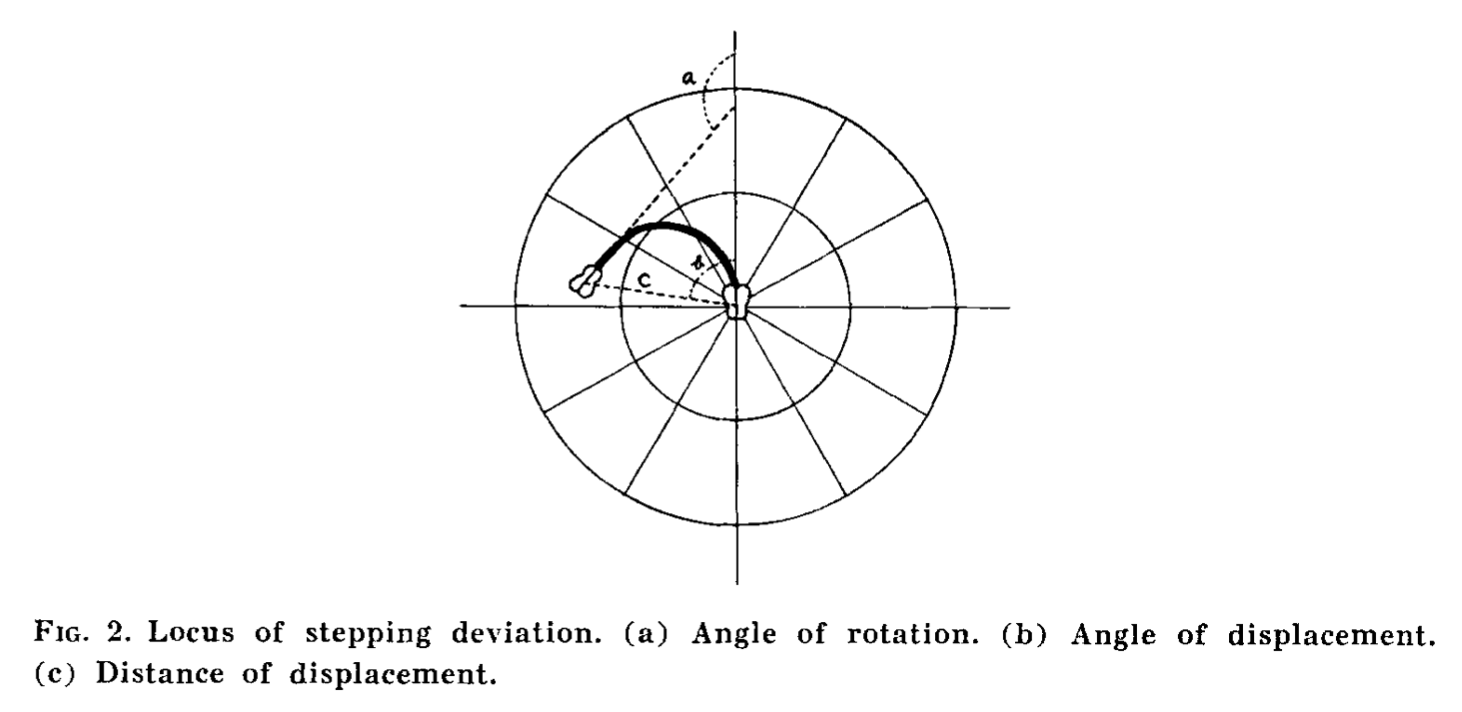
Dr. Fukuda made the point that this test sometimes identified vestibular dysfunction even in patients who had no spontaneous nystagmus. He summarized these and many other of his observations in subsequent publications (Fukuda 1984).
In the United States and Asia this test became primarily associated with the name of Dr. Fukuda, though in Europe the procedure is sometimes referred to as the Unterberger test, or Fukuda-Unterberger test (Grommes and Conway 2011).
Equipment needed
No special equipment is needed to perform the various stepping tests. Some clinicians make or purchase floor mats with metered concentric circles and angles in order to quantify displacement and rotation.
How to perform the test
In the test described by Dr. Fukuda, the blindfolded patient begins in the center of a mat with metered concentric circles and angles marked, and begins marching in place with both arms extended directly forward. Dr. Fukuda had the patients march for 50 – 100 steps. Some clinicians instead use a time-based limit, such as 30 or 60 seconds. After the patient comes to a stop, the examiner measures the distance and direction by which the patient has displaced from the origin, and by how many degrees the patient has rotated with respect to the original orientation.
What this test assesses
In theory the stepping tests can assess asymmetry in vestibular function.
How to interpret the test results
In theory this test should assess asymmetrical vestibular input; the patient will tend to rotate towards, and be displaced in the direction of, relative vestibular weakness.
There are no standardized normative ranges for the displacement or rotation in the various stepping tests.
Posterity has not been kind regarding the diagnostic utility of the stepping tests. As far as the original version proposed by Dr. Unterberger is concerned, systematic studies reach conclusions such as, “A prospective study of 26 patients suspected of having uncompensated peripheral labyrinthine dysfunction and 49 normal patients with normal labyrinthine dysfunction showed no significant difference in performance of the Unterberger stepping test between patients with electronystagmographically significant canal paresis and those with normal vestibular function” (Hickey et al. 1990).
Numerous studies have also attempted to replicate Dr. Fukuda’s original results. Overall these studies have revealed significant inter-individual variability even in healthy subjects. For example:
“The ability to keep the body aligned with the straight-ahead direction during the FST [Fukuda stepping test]… varied substantially in healthy human subjects, with a majority of subjects demonstrating significant shifts in the subjective straight ahead that often exceeded the limits originally proposed by Fukuda… Thus, our findings suggest that likely both individual differences in the orientation and configuration of the macular organs and in central processing of vestibular input and that random noise contributes to the pattern of individual angular deviations in the FST observed here” (Hemm et al. 2023).
Consequently, many reviews of the Fukuda stepping test arrive at conclusions such as, “The FST with and without head shake component is not a reliable screening tool for peripheral vestibular asymmetry in chronic dizzy patients” (Honaker et al. 2009), and “Overall, the FST provides little benefit to clinicians when used in the vestibular bedside examination” (Honaker and Shepard 2012), or at least a more cautious, “Care should be taken when using the FST to determine the side of the lesion” (Zhang and Wang 2011).
We recognize that many physical therapists still use some version of the stepping test to screen for vestibular dysfunction, and we agree that it may have a role as a screening test. However, in the context of an otoneurological or neuro-otological evaluation, most practitioners would be hesitant to reach any conclusions based on a stepping test in isolation.
Limitations
For patients whose posture or mobility is adversely affected by orthopedic problems (particularly involving the back, hips, knees or ankles), these factors may limit the individual’s ability to perform the stepping test, or may produce false positive results.
Diseases that may be diagnosed by this test
Dr. Unterberger and Dr. Fukuda originally conceived of the stepping tests as identifying unilateral vestibular lesions, of which there are many etiologies.
References
Fukuda T (1959a) The stepping test: two phases of the labyrinthine reflex. Acta Otolaryngol 50: 95-108.
Fukuda T (1959b) Vertical writing with eyes covered; a new test of vestibulo-spinal reaction. Acta Otolaryngol 50: 26-36. doi: 10.3109/00016485909129150
Fukuda T (1984) Statokinetic reflexes in equilibrium and movement. University of Tokyo Press, Tokyo
Grommes C, Conway D (2011) The stepping test: a step back in history. J Hist Neurosci 20: 29-33. doi: 10.1080/09647041003662255
Hemm S, Baumann D, Duarte da Costa V, Tarnutzer AA (2023) Test-re-test reliability and dynamics of the Fukuda-Unterberger stepping test. Front Neurol 14: 1128760. doi: 10.3389/fneur.2023.1128760
Hickey SA, Ford GR, Buckley JG, Fitzgerald O’Connor AF (1990) Unterberger stepping test: a useful indicator of peripheral vestibular dysfunction? J Laryngol Otol 104: 599-602. doi: 10.1017/s0022215100113337
Hirsch C (1940) A new labyrinthine reaction: The ‘waltzing test’. Annals of Otology, Rhinology and Laryngology 49: 232-238. doi: 10.1177/000348944004900118
Honaker JA, Boismier TE, Shepard NP, Shepard NT (2009) Fukuda stepping test: sensitivity and specificity. J Am Acad Audiol 20: 311-4; quiz 335. doi: 10.3766/jaaa.20.5.4
Honaker JA, Shepard NT (2012) Performance of Fukuda Stepping Test as a function of the severity of caloric weakness in chronic dizzy patients. J Am Acad Audiol 23: 616-22. doi: 10.3766/jaaa.23.8.6
Unterberger S (1938) Neue objektiv registrierbare Vestibularis-Körperdrehreaktion, erhalten durch Treten auf der Stelle. Der „Tretversuch” [New objectively detectable vestibular body rotation response obtained by standing still. The “stepping test”]. Archiv für Ohren-, Nasen- und Kehlkopfheilkunde 145: 478-492. doi: 10.1007/BF01583067
Zhang YB, Wang WQ (2011) Reliability of the Fukuda stepping test to determine the side of vestibular dysfunction. J Int Med Res 39: 1432-7. doi: 10.1177/147323001103900431
