By Marcello Cherchi, MD PhD
For cases of lateral canal BPPV (whether geotropic or apogeotropic), the Vannucchi-Asprella maneuver has been studied. Paolo Vannucchi, Giuseppe Asprella Libonati and Mauro Gufoni (Vannucchi et al. 2005) state that this maneuver was originally proposed by Paolo Vannucchi and Beatrice Giannone (Vannucchi and Giannoni 1998).
Vannucchi and colleagues reported the following studies of the Vannucchi-Asprella maneuver:
- Asprella Libonati reported successful treatment for three out of four patients (75%) with geotropic lateral canal BPPV (Asprella Libonati and Gufoni 1999).
- Galletti and colleagues (Galletti et al. 2001) applied the Vannucchi-Asprella maneuver and successfully treated 10 out of 10 patients (100%) with lateral canal BPPV, of whom 8 had the geotropic variant, and 2 had the apogeotropic variant.
- Asprella Libonati and colleagues (Asprella Libonati et al. 2003) applied the Vannucchi-Asprella maneuver to 55 patients with lateral canal BPPV, of whom 40 had the geotropic variant and 15 had the apogeotropic variant. Of the 40 patients with the geotropic variant, 30 (75%) “recovered immediately.” Of the 15 patients with the apogeotropic variant, six (40%) “became symptom free” and two (13%) “developed the geotropic form.”
Note that the Vannucchi-Asprella maneuver can treat both geotropic and apogeotropic variants of lateral canal BPPV. Vannucchi and colleagues (Vannucchi et al. 2005) explain this as follows:
“The Vannucchi-Asprella manoeuvre can be used to transform apogeotropic LSC-BPV into geotropic or directly eliminate both, because it causes debris to move from the cupula toward the vestibule. Its rationale is the same as that of the barbeque rotation: rapid angular acceleration moves the debris in a direction opposite to that of rotation of the head and canal; for example, if the head rotates clockwise the debris moves anticlockwise. The only difference between geotropic and apogeotropic forms is the initial position of the debris; in the apogeotropic form, the debris is near the cupula and has to travel further in the canal to reach the vestibule, making it necessary to repeat the manoeuvre a number of times. The great advantage of this technique with respect to the barbeque rotation is that it avoids movement from supine to prone and vice versa” (Vannucchi et al. 2005).
The following Figure, adapted Vannucchi and colleagues (Vannucchi et al. 2005), depicts the Vannucchi-Asprella maneuver for treatment of left-sided lateral canal BPPV.
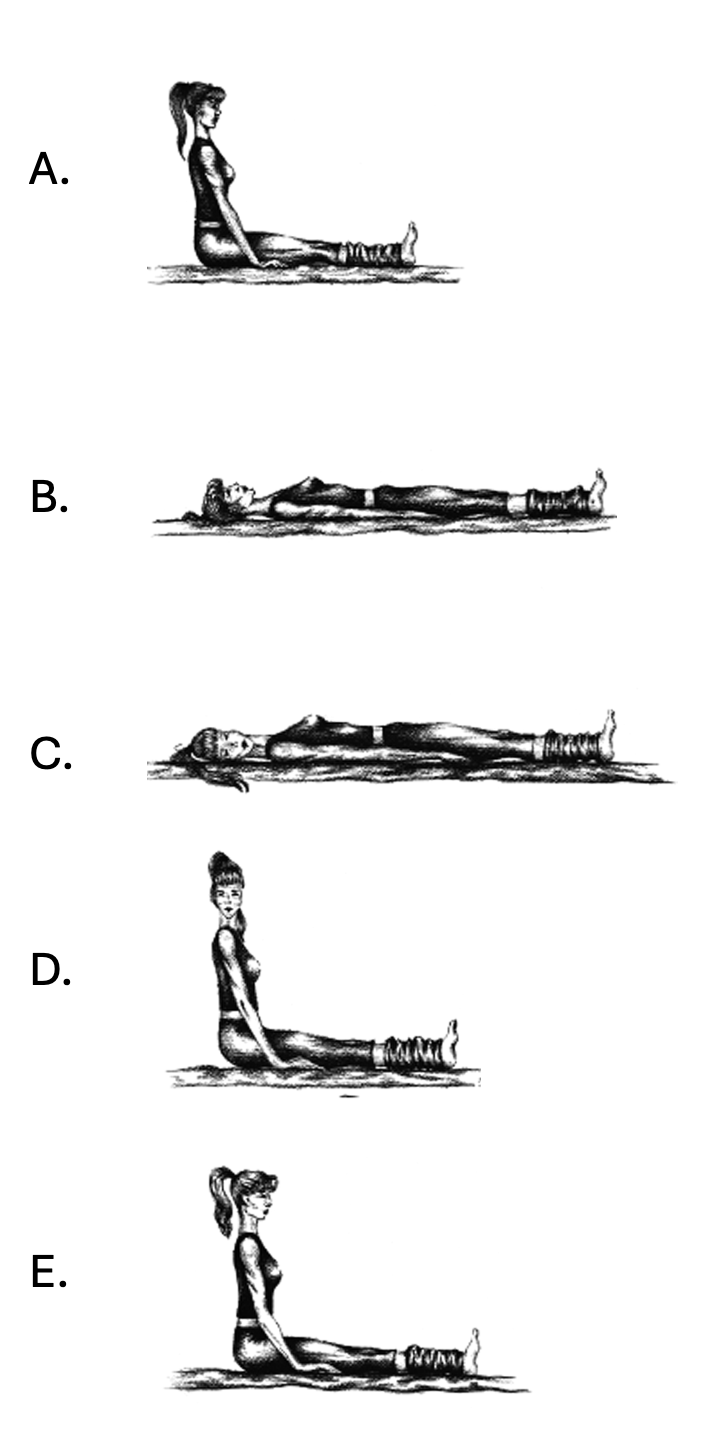
The Vannucchi-Asprella maneuver for treating left-sided lateral canal BPPV can be summarized as follows.
- The patient starts in a neutral seated position.
- The patient lies supine.
- The patient rotates the head 90 degrees toward the unaffected (right) side.
- Maintaining the head in that position (rotated 90 degrees toward the unaffected side), the patient sits up.
Vannucchi and colleagues (Vannucchi et al. 2005) state, “This sequence of movements is repeated five times or more, if necessary, as long as it does not provoke nystagmus or vertigo… Absence of nystagmus suggests that the canal has been freed of debris.”
Vannucchi-Asprella maneuver, left side, videos:
- https://www.youtube.com/watch?v=e3KAxXlcDRc (BPPV Made Easy)
References
Asprella Libonati G, Gagliardi G, Cifarelli D, Larotonda G (2003) “Step by step” treatment of lateral semicircular canal canalolithiasis under videonystagmoscopic examination. Acta Otorhinolaryngol Ital 23: 10-5.
Asprella Libonati G, Gufoni M (1999) Vertigine Parossistica da CSL: manovre di barbecue ed altre varianti. In: Nuti D, Pagnini P, Vicini C (eds) XIV Giornate italiane di otoneurologia, XIX Giornata italiana di nistagmografia clinica, Sorrento, pp 321-336
Galletti F, Freni F, Leo L (2001) Terapia della VPPB da litiasi del canale semicircolare orizzontale [Therapy for horizontal canal BPPV]. XVIII Giornate Italiane di Otoneurologia. Aspetti diagnostici riabilitativi della patologia vestibolare: stato dell’arte [Diagnostic and rehabilitative aspects of vestibular pathology: state of the art], Palermo, pp 163-172
Vannucchi P, Giannoni B Terapia della vertigine parossistica posizionale del canale semicircolare laterale, Tecniche a confronto [Treatment of lateral canal BPPV, comparison of techniques] VII Giornata di Vestibologia Pratica, ‘La terapia fisica delle vertigini periferiche’ [Practical vestibulology, ‘Physical therapy for peripheral vertigo’] 1998. CSS Formenti, Milano, pp 61-73
Vannucchi P, Libonati G, Gufoni M, Asprella Libonati G (2005) The Physical Treatment of Lateral Semicircular Canal Canalolithiasis. Audiological Medicine 3: 52-56. doi: 10.1080/16513860510029445
