By Marcello Cherchi, MD PhD
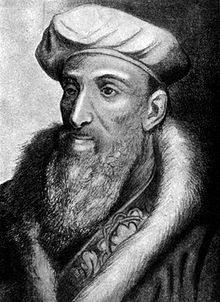
Bartolomeo Eustachio (San Severino Marche, Italy, ca. 1510 – Umbria, Italy, 1574) was an Italian anatomist who made seminal contributions to that subject. During his career he had significant disagreements with his contemporary, the famous anatomist, Andreas Vesalius. Nevertheless, Eustachio’s Tabulae Anatomicae became considered a landmark work of that era. His use of a Cartesian coordinate system to refer to specific areas in his anatomical illustrations is viewed by some historians as the forerunner of stereotactic approaches to imaging and neurosurgery (Dario, Armocida, Locatelli 2019).
Eustachio published Epistola de auditus organis (Eustachio 1562) in which he offered a detailed description of the pharyngotympanic tube, since which this structure is sometimes referred to as the Eustachian tube. Diseases of this structure may result in Eustachian tube dysfunction.
References
Dario A, Armocida GO, Locatelli D (2019) An ancestor of the stereotactic atlases: the Tabulae Anatomicae of Bartolomeo Eustachio. Neurosurg Focus 47: E11. doi: 10.3171/2019.6.FOCUS19339
Eustachio B (1562) Epistola de auditus organis [Letter concerning the hearing organ]. Opuscula Anatomica. Lugduni Batavorum, Apud Johannem vander Linden, pp 125-142
