By Marcello Cherchi, MD PhD
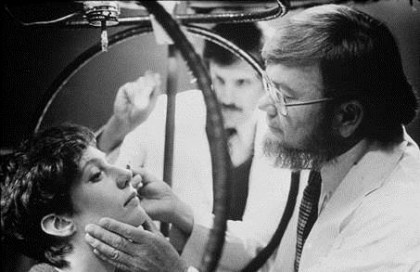
David A. Robinson (d. 2016) trained as an electrical engineer, and applied this to the study of eye movements, and developing technology to do so. He devised the magnetic induction scleral search coil technique (Robinson 1963, 1964), which has remained the gold standard of temporal and spatial resolution for measuring eye movements. He pioneered the application of control systems analysis to model eye movements (Robinson 1981), triggering a seminal shift in the way investigators thought about eye movements, enabling the development of models that offered testable predictions about ocular motor function in health and disease (Zee et al. 2019). He mentored generations of neuroscientists in this field, such as Dr. David S. Zee (Zee 2018).
References
Robinson DA (1963) A Method of Measuring Eye Movement Using a Scleral Search Coil in a Magnetic Field. IEEE Trans Biomed Eng 10: 137-45.
Robinson DA (1964) The Measurement of Eye Movement Using Magnetic Induction in a Contact Lens Coil. Biomed Sci Instrum 2: 97-106.
Robinson DA (1981) The use of control systems analysis in the neurophysiology of eye movements. Annu Rev Neurosci 4: 463-503. doi: 10.1146/annurev.ne.04.030181.002335
Zee DS (2018) A neurologist and ataxia: using eye movements to learn about the cerebellum. Cerebellum Ataxias 5: 2. doi: 10.1186/s40673-018-0081-2
Zee DS, Shelhamer MJ, Leigh RJ, Optican LM (2019) Contributions of David A. Robinson (1924–2016) to Understanding Eye Movements: An Appreciation. In: Shaikh A, Ghasia F (eds) Advances in Translational Neuroscience of Eye Movement Disorders. Springer International Publishing, Cham, pp 1-18
