By Marcello Cherchi, MD PhD
For patients
When most doctors “look in your ear,” they are using a device called a handheld monocular otoscope. This instrument helps the doctor see part of your ear canal and eardrum, and can identify problems such as ear wax, fluid behind the eardrum, or a perforation of the eardrum. During the procedure most patients are seated. Some patients find the test intrusive (because it involves inserting a small funnel-shaped object into the ear), but most patients tolerate this well. This procedure takes about 10 – 20 seconds per ear. It does not require any special preparations.
For clinicians
A handheld monocular otoscope is found in the offices of most internists and pediatricians, and in most emergency room bays.
The Figure below shows a basic otoscope.

This old, low-technology tool can be helpful in identifying some basic pathologies, such as cerumen, a significant middle ear effusion, or large tympanic membrane perforation.
Because of the anatomy of most adults, when performing otoscopy it can be helpful to pull the pinna gently superiorly and posteriorly, which often changes the configuration of the external auditory canal such as to make it easier to see the tympanic membrane.
Handheld monocular otoscopy is a reasonable screening tool, but has several disadvantages.
- The examiner must use one hand to hold the otoscope, and sometimes the other hand to manipulate the pinna, thus one hand is always occupied, and sometimes both. Thus, in many circumstances, it is only feasible to visualize, not to perform any otologic procedures.
- The illumination is often weak.
- The magnification is modest.
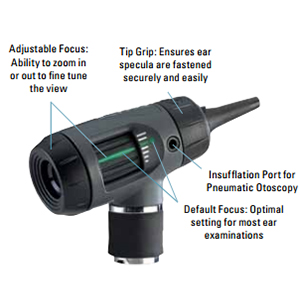
- In most handheld monocular otoscopes the focus is not adjustable, though there are some exceptions (see below).
- Only monocular visualization is available to the examiner. Without stereopsis, it is difficult to gauge depth.
The Figure below shows the Welch-Allyn MacroView Otoscope, which has adjustable focus.
Overall, handheld monocular otoscopy is easy to perform, and the equipment is relatively inexpensive, though its limitations restrict its diagnostic utility. Our practice is to use binocular otomicroscopy whenever available; if that is unavailable, then we will use handheld monocular otoscopy.
